June 2026
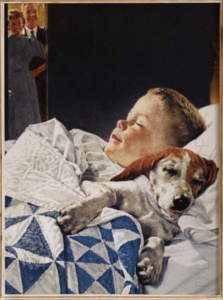
“A Boy and His Dog” (1956) by Norman Rockwell
We did a thing.
We got a dog, guys. I know lots of people have them – 43% of Americans to be precise, according to the American Veterinary Medical Association.
But this felt like a big move because we hadn’t had one for about a decade, and our lives are full, too full for a pet I said for years. In the end, my children’s pleading won out, so after my youngest completed kindergarten, we got them a pet of their very own, which especially feels like a pet of MY very own. (I’m sure most parents can relate.)
We named her Willow, and she is a 5-month-old Australian labradoodle puppy (4 ½ months when we got her.) I should have mentioned that earlier: we didn’t just get a dog. We went all out and got a whelp. She’s cute as they come, and I’ve actually never had a puppy before. My parents did the smart and practical thing and adopted older dogs.
Going through this re-homing and puppy stage has absolutely brought me back to those early days of raising babies: getting up early, being on a strict routine, prioritizing potty training above all else, and acquiring all sorts of paraphernalia the adds insist you cannot raise this little life without. In some ways, it already feels like a long time ago since we were in the baby stage (it’s funny how quickly those details become fuzzy). But Willow is triggering me…in all the best ways.
I remember worrying that a stage would last forever, the nighttime wakings or the stubborn toddler who just wouldn’t poop on the potty. And then somehow the issue resolved itself, and life subtly moved on to the next milestone and worry.
The first day we got Willow, she threw up on the ride home. I took the windy backroads without even thinking about it, and it didn’t settle too well for our fur ball. Ben cleaned up her vomit before he ever even met her. Maybe not the best start to her becoming man’s best friend, but what can you do? She then proceeded to throw up again the next day after eating a treat, and I began panicking, thinking we had been saddled with the dog with the world’s weakest stomach. Add to that some housebreaking accidents, and I may have threatened to send her back. (Not my best moment.)
Before you worry too much about Willow’s future, let me assure you we have worked out many of the kinks. We still aren’t letting me roam the entire house yet, but her stomach has settled and potty training is going well; she (usually) no longer barks when we put her in her kennel, and her daily walks have been good for not just her but the kids and I as well. We are adjusting and finding she is just as good a dog as we hoped and even prayed she would be.

But the positive transition didn’t magically happen; it took (and still takes) a lot of work. I’m getting up early even though I’m out of school, so she won’t go in her kennel. We are positively reinforcing good behavior with snacks. We are watching her carefully and redirecting her often when she tries to get into something she shouldn’t in the house. All this training, all this work, is not all that different to the training required in parenting.
There may be some things kids naturally grow out of, but many things are overcome through persistent practice and even discipline. When I looked into it online, I found there are ample people out there who compare raising a child to training a dog. Of course, it’s not the same, and children have infinitely more value, but the shared characteristics of consistency, firmness amidst kindness, and positive reinforcement are often noted.
Cali K9 said, “Whether I’m training my dog or raising my kids, the principle is the same: clear expectations, consistent response.”
Today, it can be easy to take my children’s behavior for granted, as if they always ate their vegetables or made their bed after getting up or waited until someone finished speaking before interjecting their own ideas (ok – in all honestly, we are still working on that last one.) Yet these positive results only occurred after a lot of guidance.
Today, there are still things we are working on in our children’s habits and character development that years from now we will look back on and hopefully see the fruit of our current labors. The Bible says in no uncertain terms, “Train up a child in the way he should go; even when he is old, he will not depart from it” (Proverbs 22:6.). The Proverbs note commonalities, things that are likely to happen. They aren’t absolute promises or guarantees. Still, I can think of many things I do today because of my parents’ training when I was a girl.
There are those today who would balk at the language of “training a child.” They would say we should all be free spirits who listen solely to our hearts and trust our own intuition. I will qualify this by saying that I do believe the Holy Spirit can work through intuition, but only when our hearts have been shaped to be veered Heavenward.
Even when we love the way our children dance to the beat of their own drums, there are still times where the most loving thing we can do is train them. Just as a puppy is ultimately happier trained to appreciate the safety and security of her small kennel than to be given a large room to become frantic in and likely destroy things within, so too are people happier when we know the boundaries orchestrated by God’s Word, and sometimes even common courtesy and decorum, and when we learn to function within these.
Training and discipling children is a laborious sacrifice. It requires consistency and vision and sometimes even a willingness to be the bad guy. In the Bible, spiritual leaders in the Old Testament like Eli the high priest and Samuel the prophet did great and meaningful public work, but they both failed to instruct their own sons in the ways of God.
“Eli’s sons were scoundrels; they had no regard for the Lord” (1 Samuel 2:12) and “[Samuel’s] sons did not follow his ways. They turned aside after dishonest gain and accepted bribes and perverted justice” (1 Samuel 8:3).
None of the children of either of these patriarchs followed their parents’ footsteps of godliness. It’s tragic but…it happens.
It is all too easy to forego training due to other good things, including ministry and community service, that divert our time and attention. With my puppy, the consequences of negligence are immediate and often smelly or expensive. With our children, the implications may take years to fully manifest, as in Eli and Samuel’s situation, but they will reap their rewards, or lack thereof. I do not mean to imply that our children’s every action is a direct result of our successes or failures. Sometimes kids turn out great despite their parents, and sometimes very intentional parents must watch their children go down a path they never encouraged.
Yet, there is an obvious cause and effect relationship between taking the time to train and disciple our children and the likelihood of a positive result increasing. This daily work is not always glamorous, and it can’t always be captured in a social media post, but it’s sacred work. It’s kingdom work. And it’s work we must encourage one another to keep doing.
With Willow, when I was second guessing whether we had made a horrible mistake in adding another living thing to our crew, I was so encouraged by the kind words of some veteran dog owners. One mentioned how she would rather have a longer training stage for a dog with a naturally sweet and easy-going personality (like we have.) Another reminded me of the importance of routine in the puppy stage and promised that developmental milestones are around the corner. The veterinarian and vet tech celebrated our newest member and her amiable disposition and loved on Willow (I mean, I guess that is their job, but still, it heartened me.)

In similar ways, there have been people who have come beside me in my parenting journey to give me pep talks or motivation to stay the course. Sometimes I’ve sought those resources out through books and podcasts; whatever the means of the encouragement, it has always been meaningful.
The truth is my husband and I are past the toddler and even the little years. But we still have plenty of firsts and new territory to navigate. We have a teenager under our roof for the first time and even though we like to think we know what we’re doing with our 4th (and youngest), he’s our only boy, which spices it up. Moral of the story: Ben and I still need to surround ourselves with people who encourage us to train and disciple our children, even though we have graduated from the “puppy stage,” if you’ll humor me with my analogy. Maybe you need these people too.
I know they say that a parent’s job is to put themselves out of a job, but I’m not so sure the parenting gig is ever over. It morphs and changes, but there is always something to model, even as the role changes from authoritarian to mentor and, once they are adults, friend. After Willow moves from puppyhood into her adult doggie years, we hope to continue training her. You know, teach her cool dog tricks and stuff. But with our children (here is where the analogy breaks down) we aren’t just training them to act one particular way for one particular set of circumstances. We are discipling them to cultivate character and wisdom that they can apply as needed in a variety of situations.
So, stay the course – the training and time you spend discipling your children is an investment. And I don’t know, maybe get a puppy. They’re cute.
“Training a puppy is like raising a child. Every single interaction is
a training opportunity” – Ian Dunbar