December 2025

The holiday season seems to scream more. More activities on the calendar. More décor in our homes. More treats and goodies. Just more.
Even as we try to live moderately and modestly, the sheer bulk of options, expectations, and obligations can lead to a lot of excess.
If you’re like me, you may become overwhelmed by it all. After family get togethers, my children are happy with all the holiday spoils which they have accrued. Yet I feel frantic. Where will it all go? How many duplicates do we now have? How can I ration it and pull a few things out at a time so that not everything loses its luster all at once?
Yet despite my dislike for excessive amounts of stuff, neither am I immune to an allure of abundance. While I may appear to practice aestheticism in resisting trends like placing a Christmas tree in each room of the house or buying each child a new outfit for each festive event, I have my compulsions.
I am tempted to idealize what our customs and especially traditions should be.
Those of us who don’t sit down to a full-length table filled with Hallmark worthy staples may question if we are passing down something wholesome enough.
Those of us who don’t attend a candlelight service may wonder if we are incorporating enough spiritual elements.
Those of us who didn’t get around to buying the matching family pajamas may wonder if we are fun enough.
The truth is that no matter how many meaningful traditions we engage in, there will still be other things we don’t get to. Even as my family decorates the gingerbread houses, we skip the baking. Cookies sound fun, but it also sounds like a lot of work…and powdered sugar. The closest I will come is dunking things in microwaved-melted almond bark.
In addition to the ordinary challenge of resisting keeping of with the Joneses (aka – all the fun things everyone else appears to be doing on social media), one of my biggest challenges is resisting the obligation to keep up with ourselves (by which I mean a version of ourselves from a previous year.) I tend to catalogue the number of seasonal outings and celebrations and feel the need to at least break even with what we did in the past.
Traditions are comforting, but if they become compulsory, nostalgia is replaced with legalism.
Last year we skipped the Christmas parade, which we NEVER do…except that we did. It had rained, and I just didn’t feel like getting out that night. I kind of surprised myself in veering, yet my family was fine with it. A movie night in turned out to be just what we needed.
Last summer while perusing a dimly lit flea market, I found a print that I love which now hangs at the top of our staircase. It’s a painting by Jean-Francois Millet called The Angelus (a term for daily prayer), though it was originally titled Prayer for the Potato Crop. The painting showcases a man and a woman bowed in prayer, with a basket of potatoes at their feet and the faint outline of a church steeple in the background.
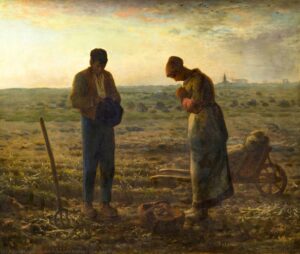
If one examines the basket carefully, she will see that these peasants have very little. There are but a few potatoes for the amount of work they likely put in. Yet they are thankful. They do not compare their simple blessing with someone else’s plenty. They have their daily bread, and they arc their heads in gratitude.
Since they are standing near the church and likely hear the bell that announces the angelus prayer time (a prayer offered three times a day in gratitude of Jesus’ incarnation), these peasants’ act is probably a learned habit despite the situation. Even if their basket was empty, they would offer a prayer in thanksgiving of something bigger than themselves and their own situation because it is a liturgy embedded just as deeply into their daily routine as the unharvested potatoes are buried into the earth.
Millet’s painting is not a holiday portrait. Yet it is noteworthy to compare its message of gratitude for simplicity and even meagerness with holiday portraits that often suggest gratitude specifically within the context of an optimal situation.
Even household darling Norman Rockwell, known for celebrating the good old days, tended to wax sentimental only about holidays of a certain sort: those filled with sound traditions, margin in the bank account, and well attended parties. And these things are blessings.

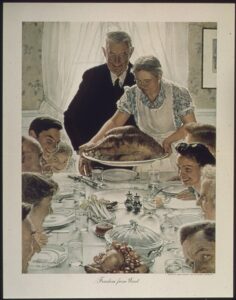
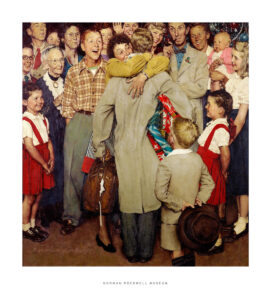
Truth be told, my life is much more akin to the characters in Rockwell’s paintings than those in Millet’s.
Yet, as I daily walk by Millet’s painting and look at those small, dirty potatoes lying in the basket, it prompts me to think of all the blessings I don’t bow my head or my heart for, all my entitlement. I don’t think the Lord wants me to feel guilty for the privilege my life affords but rather to avoid the temptation that is so common to man: to look at what I have or do and deem it less than enough.
So, as we look at the items in our shopping carts and the plans on our calendar and wonder whether they are enough to prove our own worth or show our children we love them, may we feel the security of that which is eternal. This time of year can point us to the sacred, but it can also distract us by what will rot and rust.
One of my sweetest holiday memories happened after I had been sick with a bad case of the flu while pregnant with my third baby. I had been in bed for 10 days straight and had missed doing any preparations, not to mention entirely missing finals week at my college, having no choice but to leave around 100 students with incomplete grades at the end of the semester until I could return to the grading in early January. Once I finally recovered enough to want to get out, Ben and I made mugs of hot chocolate, packed up our two littles into the car, and drove around to look at Christmas lights. I was still too weak to feel like walking around anywhere or socializing. Yet I felt such a thankfulness at being well, being with my family as my girls oohed and ahhed over the lights, and listening to holiday tunes together in the warm Volvo station wagon we had at the time. Those little gifts of quality time and health recovered were like potatoes in my basket.
Despite the algorithms and commercials telling us we should want more, do more, and even be more, Yahweh has long been in the business of showing himself as a contrast to the world’s enticements. An unknown peasant girl bled on a dirt floor as she birthed the King of Glory because He didn’t need a palace to show the world He had come to save it. We are saved from our sins and our own most polished version of ourselves. He’s with us in our ordinariness and our misplaced ambitions and our Pinterest fails.
“The word became flesh and made his dwelling among us” (John 1:14).
Pinecone picture: Photo by <a href=”https://stockcake.com/i/rustic-pinecone-display_1600931_1196672″>Stockcake</a>
The Angelus: Get a copy of The Angelus – Jean-François Millet
Merry Christmas, Grandma! By Norman Rockwell, 1949: ausdew; flickr.com; https://flic.kr/p/2mT8U1w
Freedom from Want by Norman Rockwell, 1943: “Freedom from Want,” 1943 – Norman Rockwell Museum – The Home for American Illustration
Christmas Homecoming by Norman Rockwell, 1948: Christmas Homecoming, 1948 by Norman Rockwell – Paper Print – Norman Rockwell Museum Custom Prints – Custom Prints and Framing From the Norman Rockwell Museum
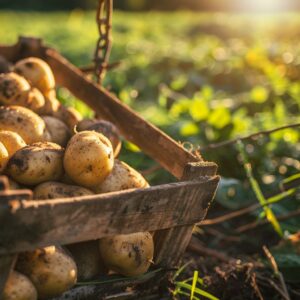
Photo by <a href=”https://stockcake.com/i/harvested-potato-bounty_776941_817185″>Stockcake</a>