September 2025
I used to think I didn’t have a green thumb. I have been known to do things like overwater a cactus and leave a plant in my office to fend for itself over a long three to four-week Christmas break.
After having given up on plants for a bit, I decided a few years ago I wanted to bring them back into our home, determining to give it another go (mostly for aesthetic reasons.) I got some small ones from clippings and replants from a couple friends. And though I was rather surprised, they grew! I’ve come to love not only the ambiance but also the routine and the spiritual lessons they offer.
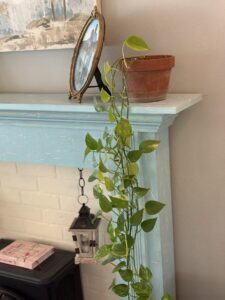
Our living room and kitchen have good light, and I discovered the places that made the plants happy. I found I liked growing something real, perhaps because it reflects all the growth happening in our home. We are nurturing little (and not so little) human beings, and I wanted our home to reflect that growth in other ways as well. I want our home to be filled with life of various sorts.
Taking the time to water every few days or every week reminds me of the careful but rewarding work that raising living things requires. It’s noteworthy how many fake plants are sold at the store. I have a few myself. They can be aesthetically pleasing, but there may be something lost through the instant gratification in which we can just go to the store and buy a plastic plant to get the desired effect rather than cultivate a shoot that will only with time and attention grow into something lovely.
Caring for any living thing takes time, money, and effort. But it is rewarding to see the growth when our children, our pets (hypothetically – I don’t currently have any), or even our plants flourish after we have nurtured them. Sometimes the growth can be so exciting it’s hard to redirect when needed.
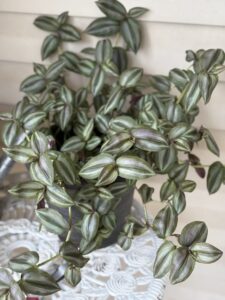
I had a beautiful Tradescantia (Wandering Jew) plant on my mantle that grew so much, its leaves cascading down so beautifully, that I couldn’t bring myself to prune it. Unfortunately, the vines got tangled, and the plant just seemed to overextend itself to the point that I almost lost it. Everything turned brown and the leaves became sparse; it looked pretty pitiful. Finally, I got out my scissors and did the pruning I should have done much earlier.
I am thankful to report that after spending the summer outside, the plant has bounced back nicely and is healthy and full. (Though it will still be a while before its leaves cascade down my mantle again.)
Putting off necessary pruning and reaping the consequences reminded me of the hard but necessary parenting I must do with my children. It can be easy to turn the other way, saying, “That’s just her personality” or “he will outgrow it on his own.” But children, like, plants, need pruning. We all do. That’s why the Lord says he chastens those he loves (Hebrews 12:6).
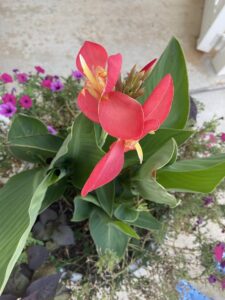
In addition to pruning, some plants require plucking. I’ve been plucking off many a dead flower from my petunias. It can be tedious, but it’s necessary. We almost lost this plant too. (I’ve improved, but I never said I’m great at keeping plants.) We thought it would be fine in the Missouri heat while we travelled but returned to find such was not the case. I had to pluck basically the entire plant, as everything was dead. But, it came back. Removing the dead gave room for the new life to bloom.
I still regularly pluck for maintenance, as the flower blooms all season if tended. And as I do, I think of the way that our walk with Jesus is not a “one and done.” There is always plucking and pruning to be done as we are shaped more into his likeness.
“People are like plants; they grow toward the light” – Hope Jahren.
How sweet are the ways in which the Lord has interwoven spiritual truths into the fabric of the natural world. Consider Jesus’ words:
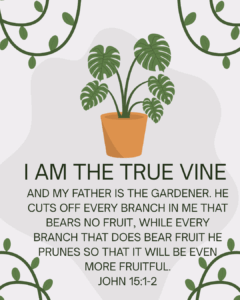
Jesus prompted us to think about the ways that nature shows us spiritual truths.
We have outdoor plants and flowers that are now well rooted, and they attract butterflies, hummingbirds, and bumble bees in droves.
Flourishing life attracts life. It becomes a hub.
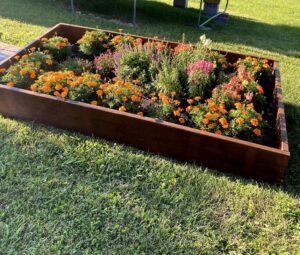
Again, this prompts me to think of what is happening within our family life. Is it attracting others who are likeminded? Is it an example to those who may be unfamiliar with the way we do things?
After my appreciation of plants had begun to grow, I read Braiding Sweetgrass: Indigenous Wisdom, Scientific Knowledge, and the Teaching of Plants by Robin Wall Kimmerer, and what a delightful read it is (though it gets more in-depth regarding plants at times than I ever thought I’d care to know.) One of the things Kimmerer discusses is the way that yellow and purple wildflowers grow together in nature to best attract bees for pollination.
I daily drive a stretch of country road near a median that is filled with yellow and purple flowers each summer, but I never thought about why. Not only is the color combo pleasing to our eye, but it’s part of the way the Creator has assisted these plants in their charge to “be fruitful and multiply,” though Kimmerer isn’t a believer and finds different rationale. Plants, like all of nature, embody both a beauty and a functionality, just as we do. Yet we, apart from the rest of nature, are image bearers who have worth and value just by existing but who also have eternal purpose and potential.
I don’t know if it’s ok to have a favorite plant or not, but I do. We call him Johnny, and we grew him from a seed. One day I was eating an apple and discovered that a few of the seeds inside the apple had already begun to germinate. So, we planted them, and one actually sprouted. We placed him in the windowsill over our sink, and the younger kids would ask to be lifted up to look at him in his little sapling state because he couldn’t be seen over the pot. Later they easily noticed that he was too cramped in the windowsill as he reached upward. The night before the kids went back to school, we moved Johnny from his cozy spot in the kitchen to a bigger pot on the front porch, so it’s a big step for him.
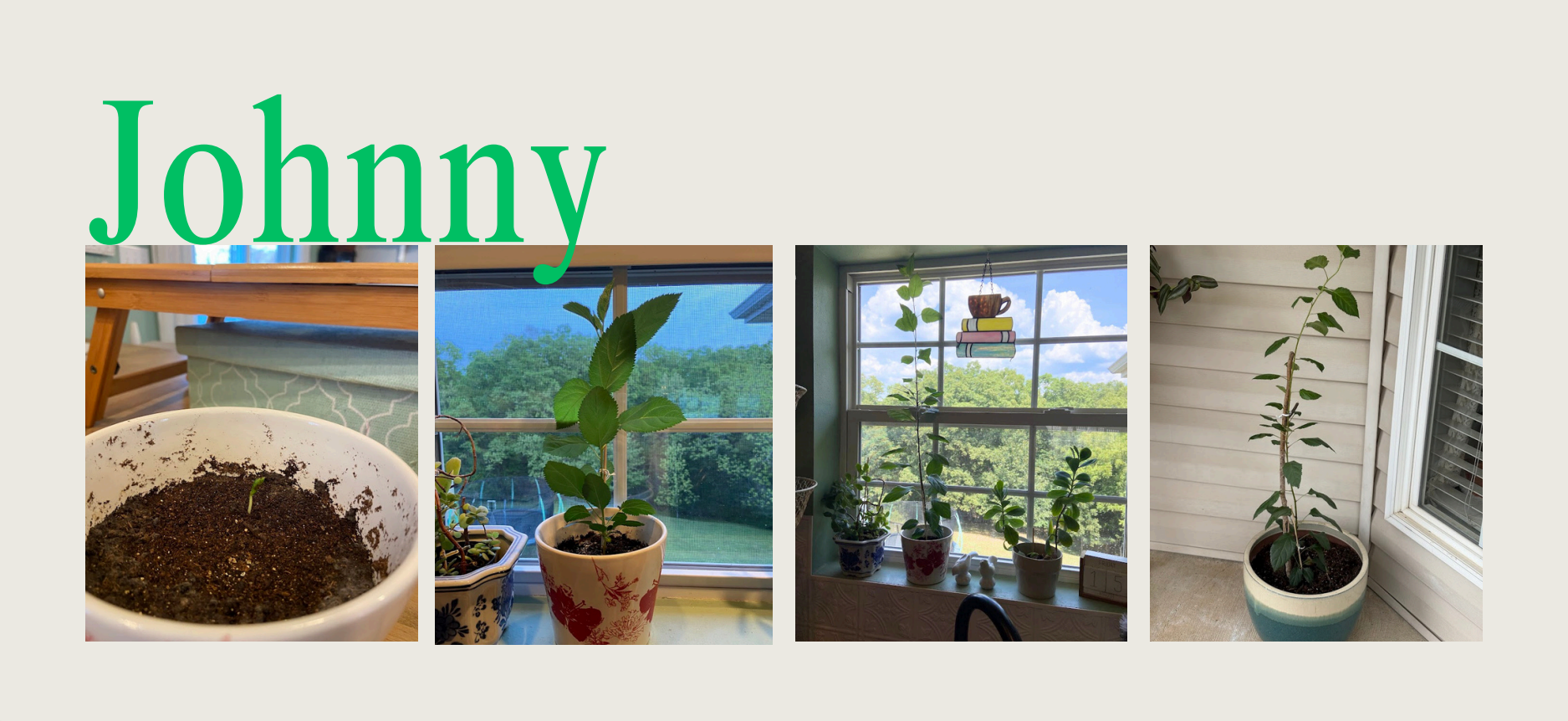
I can’t tell you how many apple seeds I planted as a kid and that my own children have planted, hoping one just might sprout. So, the fact that one did sprout feels kind of serendipitous (despite the fact that, of course, all apple seeds do indeed grow from seeds.) We have high hopes of someday planting Johnny in the yard and harvesting apples from him. Our very own tree that grew from a seed from my own apple.
Of course, Johnny isn’t the only one in my home growing. I know my children are growing and changing and will someday be “replanted,” but it can be easy to function on auto-pilot or to even wish away a season. And though I want them to grow and move on to the next stage, the phrase that kids are “growing like a weed” reminds us of how fast it really does go. We may not always be able to stop and slow down, but we can at least be intentional and try to savor it.
One of my daughter’s names means oak tree, so we have a plaque in her room that her aunt made that says,
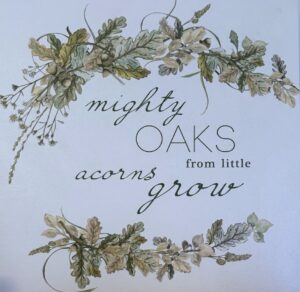
All the little moments and acts of love matter – they are the groundwork for what is to come. Roots are digging downward even when we can’t see immediate evidence of it.
Plants are a beautiful symbol of life. They literally provide us with oxygen, and they also visually provide us with the reminder of growth. Yet, even with the best of care, plants don’t live forever. Like pets and people, plants may expire even if we haven’t done anything amiss in our caregiving. It can be easy to feel like a failure if we kill a plant or perhaps see something else come to its end: a job, a relationship, a life stage.
Myquillin Smith talks about taking the plunge and buying a plant even if we know it will eventually die. She promotes “plant math” in which she encourages us to think of how much we paid for the plant and then divide it by the number of days the plant lived. Usually it comes out to a pretty low daily amount for the cost of enjoying nature each day of the plant’s life. 17: Plant Math: How to Decide … – House Rules with Myquillyn Smith, The Nester – Apple Podcasts
We can’t will a plant to stay alive forever. We also can’t will our children to enact our every desire, even good desires. When we are dealing with living things, there are best practices that typically yield positive results, but there is no guarantee or warrantee because we’re not dealing with objects. We don’t get to take all the credit or all the blame. Plants help remind me of my influence and my limitations.
Few things in this natural world remain constant and unchanged. As we know from Ecclesiastes (3:1), to everything there is a season and a purpose to everything under heaven. May we steward well the things in our care (and especially the people) but realize that finiteness is a condition, not a personal shortcoming.
Plants can be small reminders of big truths. Every time you water one, may it be a prompting of the way are also nurturing our homes, our children, and our relationships with those around us. We can’t fully control them, but we can show up with care and attention.